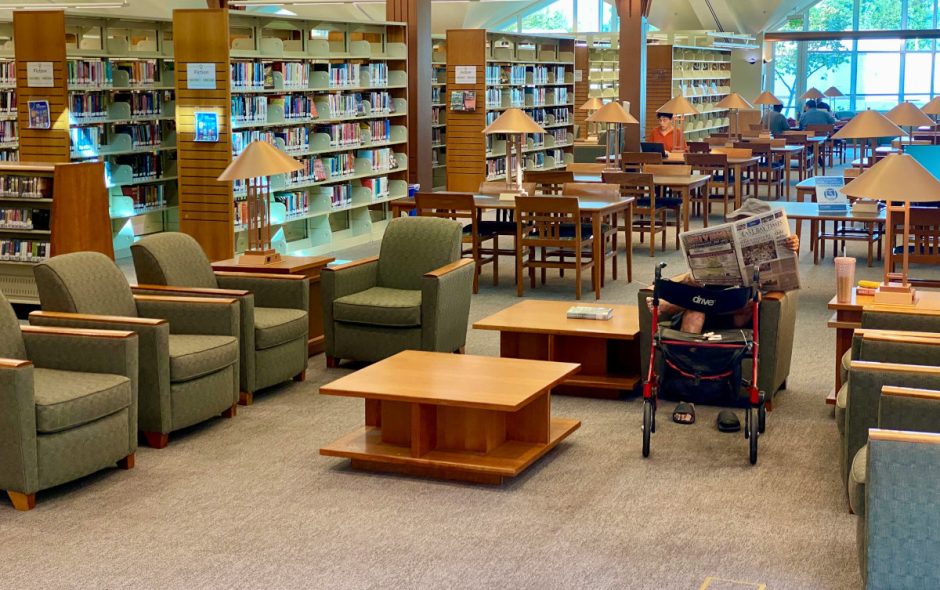
I’ve been thinking about public libraries. I’ve been in several recently, besides my own in American Fork. I had events at libraries in Provo, Logan, Herriman, Springville, and downtown Salt Lake City, plus an offsite fund-raiser for a new Alpine library.
I also saw news of an imperiled library near Logan. To save taxpayer dollars, some Cache County elected officials proposed closing it and leaving some county residents without free access to a library.
Obviously, not everyone values or uses public libraries. It can sound, oh, so trendy and wise to declare that whatever a library can offer is readily available on the Internet. It can sound, oh, so conservative and fiscally responsible to assert that whatever the taxpayers pay for libraries is too much.
I’m generally conservative but not obsessed with pinching every taxpayer penny. I’d rather conserve a civilization, including a political culture of self-government and an economic culture stacked with opportunities for have-nots to become haves. If this conservation were a shooting war, public libraries would be main battle tanks. They’re the point of the spear.
When we defend public libraries, we often hurry past the books to argue that a library offers so much more. It does, but after I acknowledge some of it, we’ll return to books.
In Salt Lake City I met a library patron who’s been out of work. He uses library computers to update his resume and answer job listings. We discussed books, society, and the heartache of unemployment.
To narrow the ominous divide between the Internet Age’s haves and have-nots, we must keep basic online resources available to people who can’t afford them, like my unemployed friend. Public libraries excel at that.
We may worry about a decaying sense of community in a post-COVID, social media-saturated world, with its “infinite content” and “infinite isolation,” to quote Austin Tindle. Libraries and city parks are among the few public spaces where people may gather without paying admission.
Do we value education? Public libraries are safe, quiet places to study and read, for teens and adults who need them. Many offer literacy programs for those who slip through the cracks at school, and reading challenges for young readers who lack encouragement at home.
It’s all important. So are video and e-book collections, chamber music concerts, art exhibits, and teen D&D meetings. But none of it eclipses the books we can hold in our hands.
We read more deeply from the printed page, and we need that depth urgently. Even in the Ivy League, reports Shilo Brooks from his teaching at Princeton, many students arrive knowing “how to read massive amounts very quickly and retain nothing.” They read superficially, for information but not experience. When he taught them to read entire books, a life-shaping kind of reading, they flocked to his classes.
The books we read teach us empathy and show us other views of the world and ourselves. They raise, Brooks says, “the deepest possible questions about human beings.” When we engage with them, we expand our humanity.
We see youth and adults crying out for purpose and meaning; struggling with suicide, addiction, and incarceration; avoiding marriage or even dating and often higher education and employment too. What if reading books could help?
I’m serious, and so is Brooks. Stories are how we make sense of the world, he says. Good books, fiction and otherwise, ground and enlarge our hearts and minds. They lure us away from endless scrolling, to confront thoughts that have endured. They model standing for something, articulating it, defending it. They point beyond money and self-indulgence to higher things. More deeply than movies and Taylor Swift, they help us ponder love, justice, duty, and truth.
Books even help us remain free. Alexis de Tocqueville warned that the American experiment requires broad and deep knowledge and understanding among ordinary people. In the 1830s much of that came from reading books, he saw, even among poorer Americans. It still can.
Maybe the people we elect can buy all the books they want on Amazon or elsewhere. But we cannot afford to limit Americans to the books they can afford to buy. We need public libraries. If we ever find we’ve elected people locally who don’t get that, we must either persuade them or overwhelm and then retire them.
Too much is at stake to play games with every American’s access to books—or to neglect to read them deeply ourselves.
This column was published in the American Fork Citizen in January 2026 and the Lehi Free Press in February 2026. Reprinted with permission. Photo credits: Martti Salmi on Unsplash and Jim Petkiewicz on Unsplash.