Tom Hanks and I have something in common: we both write fiction. If you’ve read this monthly column for a while, you may have known that about me. But did you know that about him?
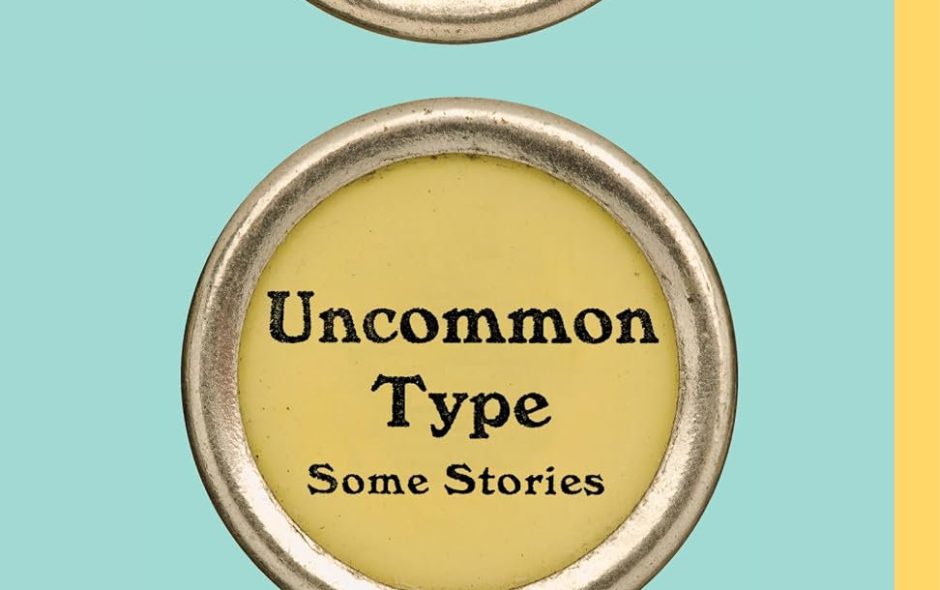
Several years ago, when his short story collection, Uncommon Type, was published, I read the first several pages, found it promising, and bought it. I didn’t read it right away; my TBR (to be read) pile is rather like a mountain range.
When I finally picked it up, my expectations were modest. I hoped to enjoy some of the stories, but I wondered if celebrity had more to do with their publication than quality. Long story short, so to speak, it was quality.
I love long novels, but short stories have their advantages. (By short I mean between five and forty printed pages, give or take.) For one thing, they offer a complete reading experience in one sitting.
They stand alone, but in an anthology or collection they may also share a common thread. In Uncommon Type each story has a typewriter in it. In “These Are the Meditations of My Heart,” typewriters play a major role, though they’re already antiques.
A recently divorced woman is moving on, putting “the Knothead” behind her. She buys a toy typewriter for five dollars at a church fundraiser on a whim. At home she wonders what one does with a typewriter in the twenty-first century. She thinks of six things immediately.
The relic barely works and cannot be repaired, so she finds a shop and trades it in for a sixty-year-old, state-of-the-art Swiss model. The old man in the shop could be in a Harry Potter book, selling wands to young wizards. He all but says that a typewriter chooses its owner, not the reverse.
It’s a charming, thought-provoking, artfully layered story, about much more than typewriters, and it fits neatly into seventeen pages.
Short stories can’t be as complex as novels, but a well-crafted short story can conjure a whole world, bring a few characters to life, and engage the mind and heart in multiple ways at once. In fact, some of our best writing is found in short stories—because they’re short.
As a writer I may spend dozens of hours creating one short story. That sounds like a lot, but it’s not. A novel takes months or years. Because my investment is so much smaller, I can take bigger risks in a short story. I can try things I couldn’t sustain for hundreds of pages and tell tales that are too small for a novel. I can experiment. I can be weird.
This has advantages for the reader too. I usually don’t even start reading a novel unless I already expect to enjoy it. But I’ll read a short story in any genre by any author just because it’s there. Some of our best reading happens with short stories.
Because it’s short, I can take more risks as a reader too. And if the one I just read didn’t land for me, the next one is a different story. I’m a lot more willing to turn the page and take a chance.
One of the longer short stories in Uncommon Type is “The Past Is Important to Us,” which combines near-future sci fi with time travel to the past. As it begins, two men are flying to New York City in a private jet with a transparent fuselage. Imagine looking through the floor of your airplane to the ground 40,000 feet below.
These are among the richest men in the world, having invented and patented the Shuffle-Access Digital Valve-Relay. One of them is hooked on time-travel vacations through a company which uses their invention. You’d think going back in time for just 22 hours, to a specific New York City hotel room on June 8, 1939, during the World’s Fair, might not be worth repeating again and again at $6 million a pop, but Bert Allenberry thinks it is.
How did the future look from the past? How will the past look from the future? What if we could go back and try a different life? It’s a wrenching, surprising tale.
The whole collection worked for me. Tom Hanks, beloved actor and director, can flat-out write. His 2024 novel, The Making of Another Motion Picture Masterpiece, is now in my TBR pile, perhaps not for long.
Originally published by The American Fork Citizen in July 2026. Reprinted with permission.
From the Author

Thanks for reading!
Comments are always welcome, within the bounds of common civility and relevance. There’s a place for them below. Absolutely no marketing, please.
Subscribe below to receive alerts of new posts by e-email.
If you liked what you read here, please consider sharing.
Do you enjoy reading fiction too? My two award-winning collections of short fiction and my new novel are available online at the usual retailers. Visit my press imprint, 60 East Press, to learn more.