Less than half a hundred years ago, in a high school gym in southeast Idaho, I gave a brief valedictory address. When the commencement ceremony ended, two parents sought me out with a question: “How can we get our children to enjoy reading books?”
Looking back, I’m not sure why parents would seek out an unmarried, childless, newly minted high school graduate with a parenting question. But I had read a lot of books, and it showed.
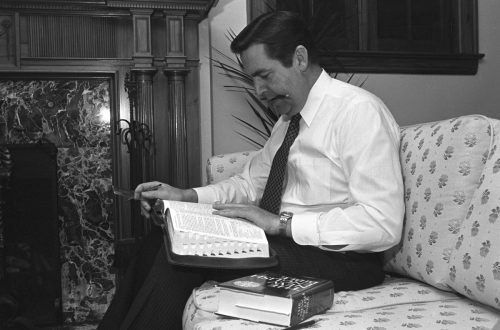
“How often do they see you reading books?” I asked.
Not often, they allowed. I don’t recall what I said next. Maybe it was, “They need to see you enjoying books.” Maybe I just shrugged, suggesting they’d answered their own question.
I had a point then, but when I get that question now, I have more answers.
I’ve written lately of reading aloud. I could have asked them if they’d read aloud to their children lately. It doesn’t become too late for that, when the children learn to read for themselves.
I reluctantly learned another useful perspective from my own children. It’s important to help them find something they like to read, put it in their hands, and—this may be difficult—celebrate the fact that they’re reading.
Why would it be difficult? Because you and I may not like what they love to read. Two of my sons had vigorous Captain Underpants phases. They read one after another of Dav Pilkey’s tales of toilet-themed adventure. Those phases seemed interminable, but they weren’t. As adults, both now devour thick history books for fun. One also reads Steinbeck, Hugo, and Tolstoy, and we talk.
Several years ago a friend approached me, deeply concerned. His young adult son had a new favorite book, Cormac McCarthy’s Blood Meridian. My friend worried that this could signal something awful happening with his son.
I knew Blood Meridian only by reputation. But in the few weeks before my friend mentioned it, two writers had recommended it to me. So I told my friend I would read and report.
Some say it’s the greatest American novel. It may be the most darkly violent book I ever read, more than war histories, Holocaust literature, and Dostoevsky. It can be difficult to read in other ways. McCarthy’s vocabulary is expansive, and he rejects a good half of modern punctuation. Yet he uses words beautifully and to powerful effect.
I saw as I read that McCarthy’s novel is loosely based on some history I’m glad I wasn’t present to witness. To a degree he reports, not invents, the violence in his tale. Nor, I think, does he celebrate violence, though he is at pains to portray his characters celebrating it. Scattered throughout are moments of generosity, sacrifice, and charity, reported in passing and without fanfare. Whether these moments are enough to redeem the novel is a question for each reader.
I gave my friend four reasons why loving that novel might not be a grim omen. Then I ended with this: “Though Blood Meridian is not to my taste in most respects, I think it’s entirely plausible that a young man could both prize this novel and be a moral, deeply thoughtful person. That said, they keep trying to turn it into a movie. If they ever succeed, don’t go.”
Our children at whatever age may read books we’d rather they didn’t. They may love books we don’t love and ignore the books we treasure. One of our roles is to celebrate the fact that they’re reading.
That said, if there’s a book you wish they would read or think they’ll love, give it to them. If they don’t read it now, they may read it later. Some of my favorite books were parental gifts I didn’t want. I eventually opened them only in desperation, when I had run out of books I wanted to read. Yet I wasn’t a hundred pages into Ralph Moody’s Little Britches or James Herriot’s All Creatures Great and Small, for example, before my fate was sealed: I would read and love the sequels too. When my children were young, I read parts of those two books to them. They enjoyed them, but they didn’t fall in love. They loved—love—other books, and they read them, and that’s a win.
This column was written for The American Fork Citizen for August 2025. Reprinted with permission. Image by ChatGPT.