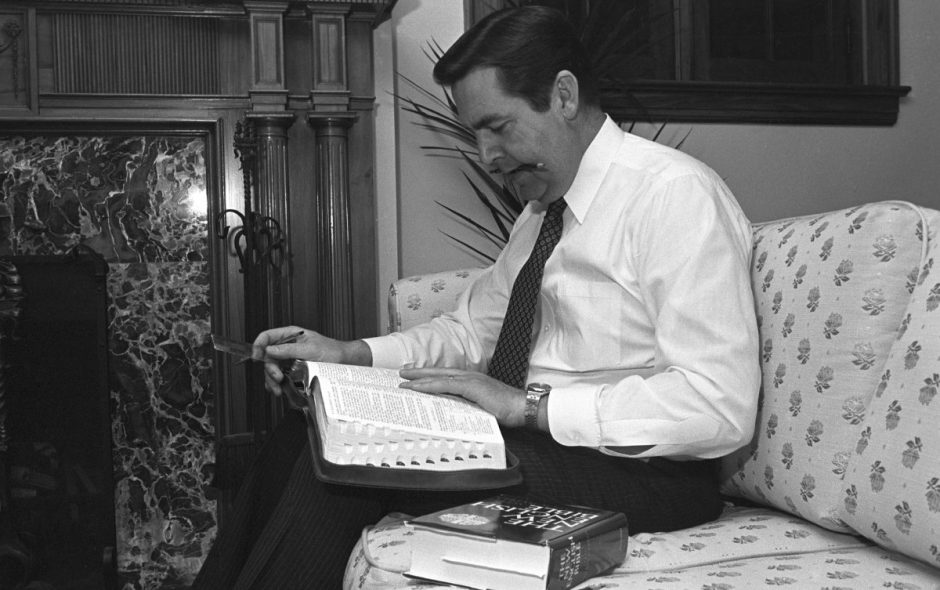
Multitudes of BYU students, Latter-day Saints, and others met Jeffrey R. Holland at a pulpit or in his writings, where he changed lives, including mine. Relatively few of us sat at his feet day after day in a classroom.
When I arrived for the first day of the freshman Book of Mormon class he taught in my first semester at BYU, I was already a voracious reader of everything from history to mystery. I had read the entire Bible and Book of Mormon. So this will sound strange: in that class he taught me to read.
For months, he led us through a text we already knew, slowing us down and showing us things that were always there, but we hadn’t seen them before. He could do this with literature, which he loved, but this was scripture, which he loved even more.
He taught us to notice details and ask probing questions. Why did the author tell this story this way? Why tell it at all? How does it illuminate the book’s grand themes? What is the human experience condensed in these lines? How can it inform our own experience and connect us to others? In a religion class we also asked, What does this passage teach us about Jesus Christ? How does it point us to God?
Many teachers have asked such questions of many students with many texts, I know. But he had a rare gift for bringing an author’s words to life in our minds.
Two years later, when I returned to BYU after my missionary service, he remembered me and hired me as a research assistant. I spent the next four years doing research for his many speeches and a book he would finally write several years after we both left BYU.
Our work on his major speeches—there were usually two of us—was to gather material from religious writings, history, literature, and elsewhere to enhance what he wanted to teach on a particular theme. We’d work at that for a month or two. Then he would add our straw to his and spend a few weeks spinning it into pure gold.
Along the way, if something we found intrigued him, he might request more research. I once spent hours preparing a memo on the literary, historical, and biographical context and significance of two lines of a T.S. Eliot poem. One December, I stayed on campus a day or two into Christmas break, to study and report a particular moment in Abraham Lincoln’s life.
We could submit nothing to him without a proper citation to its source. This was so others’ words could be properly credited, and someone studying further could find the quoted passage. It was also because he insisted on using others’ words responsibly: not quoting them out of context, not twisting the words away from their meaning and intent to serve his own purposes. Not everyone has extended that grace and professionalism to his words.
He was always grateful, encouraging, and interested in people, not just words and tasks. Eventually, he trusted me to write for him too. I was in class one day, when a department secretary delivered a note to the professor. He interrupted his lecture to say, “David Rodeback, you’re to call the president‘s office right now.”
President Holland had agreed to speak at an event that afternoon, and it had slipped off his calendar, so nothing was prepared. He’d be in meetings until the event. He needed ten minutes of appropriate remarks, which he could probably read through once before speaking.
In all, I wrote a few minor speeches for him and several major speeches for some of his associates. He heard me speak only once, at my commencement in the Marriott Center. I treasure a note he scrawled in pencil on an index card and passed to me there on the stand, praising my brief speech.
We exchanged letters and e-mails occasionally through the ensuing decades. This never changed: the only thing about him that was bigger than his intellect was his heart.
At BYU he taught me to read and to cite, and trusted me to write. There and in the decades since, his example has guided my own best teaching, mostly at church but also at major universities. So I use the present tense advisedly: In death he is still my teacher. I am still his student.
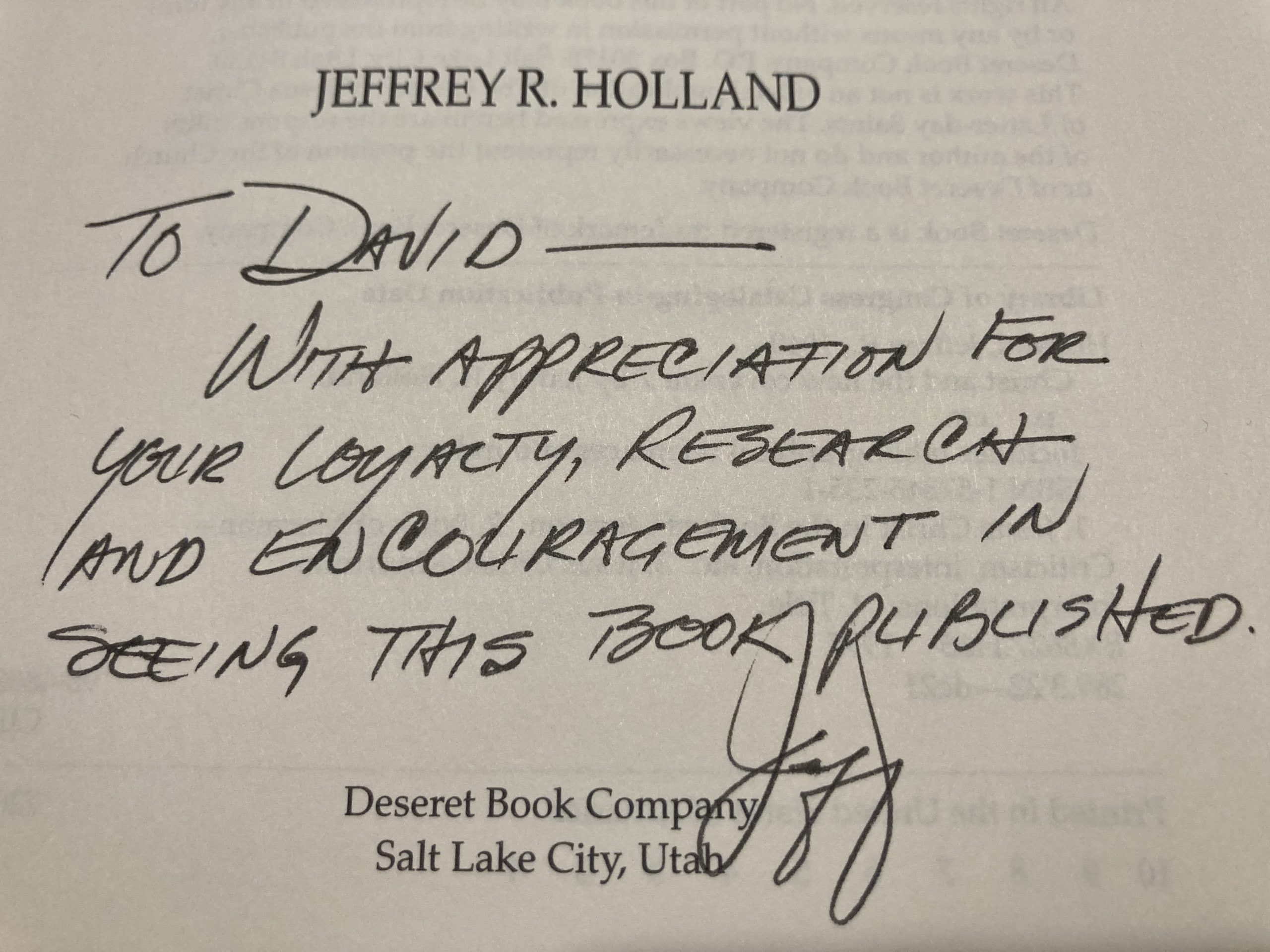
Originally published February 20, 2026 in the American Fork Citizen, p. A8. Reprinted with permission.
Photo of Jeffrey R. Holland courtesy of the Church of Jesus Christ of Latter-day Saints. Used by permission.